Sunday, April 21, 2013

Duck confit or stuffed chicken leg?

This week has been all about cooking poultry.
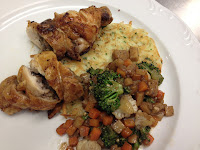
Stuffed Chicken legs with Pecan Butter
As I mentioned last week, the current module is structured in two-day sessions, one day prep and the other day is reserved for cooking. As you may remember, last week I wrote about the importance of mise en place and being prepared. Having been able to get more organized on my prep days this week, I was able to think a little bit more about cooking methods. I believe the recipes for this module are being put together to maximize our exposure to a variety of different ways to cook vegetables, starches and, of course meat. How else would one justify cooking a recipe of Stuffed Chicken Legs with Pecan Butter, Vegetable Curry and Potato Pancakes or Grilled Chicken Breast with Grilled Vegetables and Masoor Dal (Red Lentils with spices)? I am surprised my stomach still knows in which country it is in.

But to be serious, although the recipes as a whole sound strange, the individual components require different techniques and skill sets to be prepared. And since the protein is usually the most expensive item on one's plate, it pays (literally) to showcase it as a tasty centerpiece of the plate.

With regard to the two chicken recipes mentioned above, we cut up a whole chicken and then, to be able to stuff the chicken leg (in this case it included the chicken thigh), we de-
Stuffed Chicken legs, ready to cook
bone them as well. Without getting into too much detail here, there are different methods for de-boning, but the final goal with all of them is to be as precise and non-invasive with the cutting as possible. A little bit like a surgeon's skill set; small incisions but cutting out everything that is unwanted. I can tell you right now, it takes more practice than I thought it would. In the end, my stuffed chicken legs looked okay, but it took me a while to get there. The effort turned out to be very worthwhile particularly as I happen to love the pecan stuffing. It was very tasty.
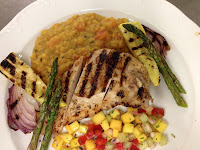
Grilled Chicken breast
The second recipe included a Frenched chicken breast supreme or as it is also called airline chicken breast or Statler chicken breast, that latter name originating from the Boston Hotel Statler, which is now the Boston Park Plaza Hotel. It is essentially a semi-boneless chicken breast with the 1st joint of the wing bone still attached. Unfortunately I don't have a picture which shows just the breast piece, but if you google any of the above names you will find some images.
The other items of the recipes were fairly easy to prepare, as I had taken Indian vegetarian cooking classes when we lived in Chicago, and, of course growing up in Germany, we ate potato pancakes at least once a month.

The second set of recipes of this week, focused on duck (a favorite of my mine) and turkey. Although I really like duck, until now I had only ever prepared it for Christmas dinner and only roasted it as a whole bird. For a while now, I have been meaning to buy some individual breast pieces but their shrink wrapped size in the store never really seemed to justify the price tag. Hence, I usually bought chicken instead. See what I mean by protein being the most expensive part of your meal?!
So, for the duck recipe, we were asked to prepare duck leg confit and to pan-fry the duck breast. I was getting really exited since I had heard a lot about the exquisite task of duck confit, but so far had not eaten it myself. According to my course book "Professional Cooking" by W Gisslen Edition7:"...confit of duck and goose originated as a  by-product of the production of foie gras...". What a nice by-product it is. The seasoned duck leg is placed in a small sauce pan, completely covered with duckfat and cooked it until tender at a relatively low temperature, which, depending to whom you speak, is between 250°F to 300°F. Once tender, the leg is removed from the sauce pan and place under a broiler to brown and crisp the skin. Yummy.  The meat, because it is braised in it's own fat, is very flavorful and tender. Again ....... yummy!
Duck leg confit and pan-fried duck breast
After this wonderful experience, I am reluctant to admit that I totally over-cooked my pan-fried duck breast. Something went wrong when I was trying to render the fat from under the skin and the breast piece never quite recovered from it. Nor did I. After talking it through with my teaching chef, I will certainly try again, because it's actually not that difficult to make. A duck breast is put skin-side down in the frying pan to sear the skin and render some or all of the fat from under the skin. Depending on how one would like to serve/eat it (rare, pink or well-done) it can be finished off in the oven or served straight from the pan. I guess the fact is, things do go wrong in the kitchen, particularly when one (in this case me!) is confident that one can do everything perfectly. It is how we learn from our mistakes that make us better cooks in the end.
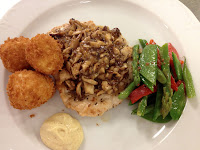
Turkey Scaloppine with Shiitake Mushrooms
The other recipe of this two-day session featured turkey scaloppine with shiitake mushrooms, potato croquettes and spring vegetables with a light mustard&honey vinaigrette. The turkey scallopine is very delicate and went well with the shiitake mushroom sauce and the spring vegetables (asparagus, green beans and snow peas). These vegetables were blanched and than shocked in ice-water so that they stopped cooking immediately and kept their green color. What I didn't know is that acid turns green vegetables brown. That meant that I was only able to dress the vegetables with the vinaigrette immediately before plating and couldn't 'marinate'  them a little longer in the dressing as I had done previously at home. I was convinced that that meant they vegetables would lack flavor, but I was wrong. It actually worked well; the crisp taste of the fresh vegetables with a little spice and sweetness from the vinaigrette. I will repeat that again to experiment a little more with the flavors.

But for now, I hope you have a great week and happy eating.


Sunday, April 14, 2013

Mise en place - 'Everything put in place'

It has been a great week and a good start to my Culinary Foundations III course. I think we have started to cook with the 'grown-ups'.
Each cooking session is divided into two days, one day for mise en place and the second day for actually cooking the dishes. The emphasis of this module is on cooking techniques and the recipes are less descriptive than they were in Culinary Foundations II. We are encouraged to interpret the recipes in our own way, for example by adding additional spices or seasonings if we feel it will benefit the dish. Another focus of this module is on plating. All plates are a complete entree, which means each plate contains a protein, starch, vegetables and a sauce. The question is how do we want to present the dishes so that they are shown to there best advantage?
You can imagine that all of this requires a lot of planning. Planning my preparations for day 1 of the session and planning my cooking routine and my plating for day 2. That's where the mise en place comes in. It's literal translation from French means 'everything put in place'; for me it means 'know what you are doing, have a plan and get organized'. It's a phrase we've been talking about since day one at the school, but now it's really coming into it's own right. One of my chefs once said that " the best chefs are the ones who are most calm". I now totally understand why. Proper mise en place definitely makes the difference between frantic chaos and frantic cooking.

Let me explain what I mean. Our first two dishes of the module were beef stew with vegetables together with tournéed potatoes, and roast pork loin with apple & sage sauce and Bulgar pilaf. As you can see this is a lot to prepare and cook. On day 1 we measured out the portions for protein, vegetables and starches, chopped all the vegetables, and got the seasonings together for the protein and the vegetables. While performing these tasks, I was also thinking about how to plate my dishes the next day. To what size should I chop my vegetables for the beef stew? Was I cooking them with the beef stew or separately? If I 'd cook them with the beef stew at what point during the cooking time would I add them so that they wouldn't totally lose they color and shape? In the end I decided to cook the vegetables and potatoes separately, which meant they would retain their vivid colors and be very visible in my dish, which in turn demanded that they had to be cut in visually pleasing shapes and all the same size. The same decisions needed to be made for the roast pork loin dish.


Roast pork loin with apple & sage sauce and Bulgar pilaf and carrots etuver
Once all my preparations were complete, all the little prep bowls labeled and I had visualized how to plate my dishes, I needed to decide on a schedule for my cooking processes for the next day. I knew my beef stew would take a long time to cook, so that needed to be my first priority on day 2. That in turn meant that I would need to switch on the oven immediately when I came into the kitchen the next morning. I would get the beef stew in the oven and than focus on the pork loin dish while the beef was cooking for about 60 to 90 minutes. The pork needed to be browned on the stovetop, than cooked in the oven, and subsequently rested once the cooking process had been completed. I was evaluating those times against the time the Bulgar pilaf would take to cook in the oven. And what about the reduction of the cooking juices to make the apple & sage sauce for the pork loin? I decided to get the pork going first than get the Bulgar pilaf in the oven and as the pork was resting, concentrate on the preparation of the apple & sage sauce. In between those steps to prepare the roast pork loin dish, I was also keeping an eye on the beef stew so as not to overcook the beef. Luckily, the beef took it's time, and I was able to prepare and present the dish to my Chef instructor, before I needed to focus on the beef stew.

Beef stew with tournéed potatoes and vegetables etuver
Once the pork dish was out of the way, I went back to my beef stew. I started to cook the potatoes and vegetables, strained and reduced the sauce for the beef stew, and finished off the seasoning. It all went smoothly and I was very happy with both dishes I produced that day.

However, things don't always work out that easily. Our next two-day cooking session consisted of cooking two fish dishes, Sole Meuniere with baked tomatoes, braised endives and farro-risotto as well as Paupiette of Flounder with Salmon Mousseline, Quinoa salad with bell peppers and buttered Asparagus. Those are two dishes that require a lot shorter cooking times and much of the work had to be completed in parallel, which meant that proper organization and planning were even more important. So focused was I on ensuring that I got the timing right that that I actually forgot to take pictures of my finished plates that day! I was trying to keep an eye on everything and more importantly ensuring nothing burnt.

To sum it up, before I started culinary school, I used to think that only dishes cooked in a wok needed prior preparation of all the ingredients. Now I am just starting to appreciate that mise en place should be a 'way of life' for everyone, never mind what one cooks and never mind at what level the cook operates. It's the difference between chaos and efficiency in the kitchen.

Have a great week and happy eating.

Sunday, April 7, 2013

For the love of Chocolate

Today (Sunday) has been the last day of my Spring Break and I can't wait to get back into the kitchen at school. I feel like I have truly taken a break from cooking - I did nothing but bake during my short vacation. There was no rest for the wicked. After my Easter Bread baking marathon, I moved on to baking with Chocolate. Sometimes the stars aline and one is destined to bake great things.

Pecan Sandies
A few weeks ago my friend Eva posted a recipe for Pecan Sandies from the Thomas Keller 'Bouchon Bakery' book on her freshfromevaskitchen blog. I felt inspired to bake and the cookies were really yummy. We had been to the Bouchon Bakery a few times when we lived in San Francisco and so I decided to treat myself to the book. And what a fabulous book it is. I could hardly wait until my Spring Break to try more of it's recipes.
 The perfect excuse for my baking mania was the visit of my girlfriend from San Francisco who arrived on Easter Monday. She is a self-confessed chocaholic and has come to expect nothing less than being treated to the best chocolate creations when at my house.

So, I started by baking one of my favorites - Sweet & Salty Chocolate Cake. Co-incidentally, this is also a recipe from my friend Eva's freshfromevaskitchen blog. The cake takes a lot of preparation and assembly work, but once you taste it, you will notice it's worth the effort. The combination of sweet and salty really works, but you must spare no expense and buy some french fleur de sel salt as requested in the recipe. It really makes a difference and I speak from experience. Anyway, the cake is pure decadence, so I decided to scale down the recipe for a smaller version for next time. Nobody can deal with that much chocolate, although my girlfriend made a pretty good stab at it.
Three layers held together by salty caramel and chocolate ganache
The finished cake with more chocolate ganache


The next thing I baked were the brownies from the 'Bouchon Bakery' book; they contain more cocoa powder than flour: lovely. The great thing about the book is that the recipes have been adapted for the home cook and are very easy to follow. Some of the techniques used in the recipes are classical French but all are well explained and possible to re-create at home with little effort. As you know I am not a frequent baker (although after the last 10 days, one might think otherwise) and so I was surprised to learn that the recipes where measuring the eggs by weight. Why and how? It is done by cracking and whisking the eggs in a bowl and than straining the beaten eggs into another bowl as so to remove the chalazae (that's the white tissue that connects the egg yolk to the egg's membrane) and any tiny fragments of shell. A little bit more work, but genius. I found the egg to be much smoother and mixing better with the dry ingredients. The recipe also requires the dough to rest for approx 2 hrs before baking. Now, I don't know the scientific explanation for that, so I can only speculate that this helps to combine the various ingredients more effectively than when baked immediately. Whatever the reason, it works. The brownies are awesome and don't seem to last long in my house.

With all this baking going on over the last week, I have to admit that I sometimes had to cut short my dog walks in order to follow the timetables for the recipes. Not fair on the dogs, I thought, particularly since they weren't getting any of the goodies. So, feeling somewhat guilty I set out to bake some dog treats. Sure enough the 'Bouchon Bakery' book has a recipe for those too, and they sell the dog treats at the Bakery. According to the story in the book, the bakery used trimmings of fois gras from the restaurant for the dog treats, though the recipe in the book uses chicken liver and bacon. Very fancy, right?! My husband couldn't believe the smell of bacon streaming through the house wasn't destined for his delight but for the dogs. Since Easter was just gone, I decided to create some bacon and liver Easter bunnies. From the picture, it looks like quite a mess of blood on the parchment paper, but no worries as there is no real blood involved. In fact the dog treats are glazed with a ketchup mixture and then dried in the oven again. It surely smelled good in our house all afternoon and the dogs couldn't believe their luck.

Time to go and get my knife kit ready for tomorrow. I start again with a 4 am wake-up call and I am looking forward to the next 6 weeks of Culinary Foundations part III.

So stay tuned, have a great week, and happy eating. 


Monday, April 1, 2013

Easter Baking Marathon

Easter Bunnies
Happy Easter Monday.
After successfully completing my Culinary Foundations II course earlier last week, I seem to have taken a break from cooking and crossed over to baking. I love baking at Easter, funnily enough I don't really know why. I am not a particularly frequent baker but there are a few occasions during the year where I feel compelled to bake. Easter is one such occasion. Last year, I was totally obsessed with producing Gourmet magazine-worthy decorated cookies. I uploaded a picture of my efforts and you can make up our own mind how well I did. :-)

 This year, I have been thinking and talking about Easter Breads for the last few weeks and on Saturday I had an Easter Bread baking marathon in my kitchen. My husband asked the obvious question "What is an Easter Bread?" Well, for me it's a slightly sweet, yeasty tasting bread that is braided in a loaf or a ring shape. In Germany we call those shapes 'Osterzopf' or 'Osterkranz' and you will see them in the pictures below. Having said that, the definition of an Easter Bread varies depending on the country from which it comes.

Osterkranz
I've prepared 3 different Easter Breads. Each recipe appealed to me for a different reason and interestingly, each recipe used a different type of yeast.The first one I prepared is a 'Osterkranz' from an original German recipe sent to me by my mum. It uses fresh yeast which is actually quite hard to find in the US and is much more widely used and available in Germany. I really like the taste of fresh yeast in baked goods but particularly in an Easter Bread. It is hard to describe the taste to you, apart from the fact that it is a very distinctive. I like it, but it might not be to everyone's liking.
Osterzopf
I wanted to compare the 'Osterkranz' recipe to the 'Osterzopf' recipe, which has been my go-to recipe for the last few years here in the USA. It's a German recipe which I found on a blog called 'The Foreign Kitchen'. The differences in the recipe are that it uses instant yeast and honey is substituted for sugar. The overall flavor of the bread is a lot milder because of the instant yeast. I prefer the 'Osterkranz'.

Holiday Bread for Easter, NYTimes
The third recipe it actually a recipe I took from the New York Times Dining & Wine section. It is actually an example of what I was mentioning earlier, that each Easter Bread recipe varies depending on the country of origin. This recipe differs from the German ones, in that it contains currents, cranberries, etc as well as anise seeds and citrus zests. The type of yeast used is dry active. The bread is sweet, flavorful and the yeast taste is a little bit more prevalent than in the 'Osterzopf' recipe. Although I wouldn't necessarily associate this bread with Easter, I like it.

To summarize my Easter Bread baking marathon, it was an interesting experience. I love baking with yeast and I really enjoyed comparing the different baking processes and flavors. I've probably put on a couple of pounds while tasting the different breads. The good news is I found my favorite quite quickly. It's the basic German recipe with the fresh yeast, just as my mother used to make it. I guess my choice is no surprise. It's hard to get away from those comforting childhood foods with the happy memories attached.

Watch this space, I have the feeling there is another baking blog coming along next week.
Have a great week and happy eating.

Sunday, March 24, 2013

It was all a bit fishy


Grilled Pork with Pommes Purée

Escalope de Veau à la Crème
This week's blog is not for vegetarians; it's been a fish and meat week at school. As we are increasing our skill level, the dishes we are preparing are becoming more complete (starch, vegetable, protein) and the recipes become more sophisticated. On Monday we started with grilled pork and veal escalope and finished on Friday with first filleting and then cooking fish. In the days in-between we trimmed chicken, trussed chicken, de-boned chicken, roasted a chicken and stuffed the de-boned chicken legs and breasts.

So, if you, like me, want to know all about fish and meat preparation it's been a really good week. If not, it was a hard week to get through.


Flounder, partially filleted with roe sack
Salmon skeleton
Sole Meunière
Poached Salmon with Beurre Blanc
Although to be perfectly honest, I would have to admit that preparing the chickens has been an easier task for me than filleting the fish and cleaning the fish bones. Although I have no rational explanation to why I feel this way. Perhaps we are generally less familiar with preparing whole fish; fish fillets are readily available in every supermarket whether it is pre-packed or from the fish counter. And even at a fish mongers, one would seldom buy whole fish these days.


Chicken, set up for preparation
In contrast, as a society we seem to love our chickens; whole or in pieces. Rotisserie chickens are sold in every supermarket and very popular judging by the speed with which they disappear from the warming-shelves. Pieces of chicken meat seem to be on special offer on a weekly basis. Whether the low prices, the abundance and quality of chicken available is ethically correct is a different discussion and perhaps not one for this blog (at least not for today).

The chicken is ready for roasting

Roasted chicken, breast and leg pieces
I have included a lot of pictures this week of dishes we prepared. The veal, pork and fish dishes I will need to re-create for our final Culinary Foundations II exams tomorrow (Monday) and Tuesday.
Yes, that's right. Another 6 weeks have gone by and I will be finishing my second module this week. I've been working all weekend on my book report (I've reviewed a book about the history of peanut butter, for which I have a great affinity) and on preparing ingredient lists and prep sheets for the dishes I have to cook. Which, unfortunately, has left me less time this week to dedicate to this blog. I hope you enjoy the pictures, get an appetite and I will come back to you with more elaborate stories next week. I promise.


Have a great week and happy eating.


Sunday, March 17, 2013

Prepping for Easter

Before we talk about Easter, let me say:
                                            "Happy St Paddy's Day everyone!"


We have just come back from a dear friend's house where we had a little bit of a celebrations. A fab afternoon with a couple of Irish friends, some Germans and a Brit. What better mix can there be?! :-)


Easter is coming,  I can see the signs everywhere. The snow is melting, the days are getting longer, and at a friends house I ate my first chocolate Easter egg this week. Quite timely, at culinary school, it's been a week of egg, lamb and fish preparations. All things I associate with Easter.

Perfectly poached eggs
Wednesday was 'Egg' day at school. My husband and I love eggs and so I have been preparing eggs for weekend brunch for years. Despite all this practice though, I am the first to admit that cooking a perfect egg is not that easy. I think cooking the perfect egg it's a task one has to perform with love. For example, my husband really likes poached eggs. A simple dish, right?!? Well not quite, for me anyway. I grew up with soft-boiled eggs, so poaching the eggs perfectly has been a challenge for me ever since I tried it first. I have also gone to great length to convince him that other ways of cooking an egg are so much more interesting; to be honest simply because I felt much more comfortable to boil and egg or fry in in the pan. Not anymore! I have finally mastered  the art of poaching an egg and it is divine. It's so simple but so delicious (given one uses very fresh tasty eggs) that I cannot believe I spent so much effort convincing my husband otherwise.  As you can see on the picture, the egg white should just be set, while the egg yolk is very easily oozing out when cut. Perfect.
 
Deep fried egg
French omelet with fines herbs
One of the things I really like about eggs, is their versatility. There are so many different ways to prepare an egg that one could easily put a weekly breakfast menu together and never get bored of eggs. That day at school, we also prepared a French omelet, an egg over-easy and a deep fried egg. Yes, even eggs can be deep fried. How decadent is that? We placed it on top of a noodle dish that one of the chefs from the other classes brought in for us to try.The french omelet is a much more delicate omelet compared the ones we mostly eat here in the US. It is has a shorter cooking time so that the egg is just set and instead of flipping it over to cook both sides it is folded into a neat oval shape. Some chefs place the filling inside the omelet before it is folded, others cut a pocket into the top of the oval shaped omelet and place their fillings into it. Above picture shows you my version with a pocket cut into the top of the omelet.


Navarin of Lamb
Semi-boneless leg of lamb
The other item I associate with Easter is eating lamb on Easter Sunday. I happen to very much like lamb what ever time of the year. Usually I would prepare a leg of lamb, based on a recipe by Nigel Slater who is one of my favorite food writers. And I like to eat it on the rare side of pink. What I hadn't tried yet, was to prepare a lamb stew, and that is excatly what we did in school on Thursday. I was a little disappointed first because I have prepared many beef stews before (we call them Gulasch in Germany), so I thought I wouldn't learn much that day. But, trust the French to make it interesting, they prepare their stew on a much more sophisticated level. Navarin of Lamb (brown lamb stew) is certainly not a one pot dish. The meat is braised very much in the same way than I would prepare it for Gulasch; however, the vegetables are a whole different story. First , some of the vegetables are tournéed, that means they are cut in the football shape called Tourné I talked about in one of my early blogs. Then, all the vegetables are prepared separately. That means the green beans are blanched, the tournéed root vegetables are steamed in a buttery liquid and so on. In addition to this, the sauce of the braised meat is strained to create a perfectly smooth texture but with all the flavor of the mirepoix, herbs and spices.  So, about three or four saucepans later, all the components are finally arranged on the plate, with the perfectly cooked vegetables still showing their natural bright colors rather than being a brown-ish, over-cooked part of the stew. And because they are cooked and seasoned separately, they create a more complex flavor profile for the stew. Very nice indeed; rustic Gulash no more. From now on, more stews will have a sophisticated edge.

Finally the fish for Good Friday. We did have our 'Fish and Chips with tartar sauce' day at the college last Friday and we eat some fish at night for dinner at home. At college the fish was breaded and pan fried. Although I love all things fried (especially french fries), at home we opted to steam the fish and therefore create a more healthy version. The item we didn't skip on was the tartar sauce I had made at school earlier that day. We prepared a  basic mayonnaise and added ingredients such as lemon juice, capers, shallots, gherkins and fresh herbs (parsley, chervil and tarragon). Delicious.

So, all there is missing is for Easter is the pastry. At school we won't be doing any baking just yet, but at home I will. A few years ago, I found a good recipe for a traditional German Easter Bread. I am certainly looking forward to baking it and i will let you know how it turns out.

Until then, I wishing you a good week and happy eating.


Tuesday, March 12, 2013

Vegging out, perfectly starched

I know, I know. It's already Tuesday today and I am two days late with my post for this week. I apologize for that. I've been cooking  a lot and time is flying when I am having fun in the kitchen. It was pizza party on Sunday night which unfortunately meant I wasn't able to write this post.

But back to my school curriculum; we have finally moved on to solid foods, vegetables, legumes, grains, potatoes and other starches. It's been a very rich learning experience cooking all those different foods last week and we are continuing with the theme this week.

The first couple of days last week was all about vegetables and legumes. So, we prepared dishes such as Cranberry beans and Asparagus salad with Parmesan shavings; Frijoles Refritos (re-fried beans) with cheese and deep fried tortillas; Green Bean Sauté; Carrots Vichy; Hummus; etc. The purpose of preparing all those different dishes is that we learn the technique of properly cooking legumes, of how to correctly blanch vegetables, of how to prepare individual ingredients and then putting them together as a dish. So, for example, in order to keep the vivid green color of green beans and asparagus, the vegetables have to be blanched in rapidly boiling water and then they are 'shocked' in an ice bath to stop them from further cooking, while the Cranberry beans are getting their final seasoning or the lardons (French beacon pieces) are being sautéed in the pan. Carrots Vichy are carrots that are steamed in their own juices and with the help of a dollop of butter, since very little is done without butter in French cooking. But, of course, they taste really great. Frijoles Refritos (re-fried beans) are actually cooked twice; that means first they are simmered to soften them, then they are mashed up with seasoning and fried in a pan with some oil. To be honest that was news to me. Okay, I am not a big fan of re-fried beans, and now I think I may know why. Most of the Mexican restaurants at which I have eaten  seem to have omitted the last (re-fry) step and serve the beans at a consistency that is more comparable to mashed potatoes. The ones we made at culinary school, were much better in taste and texture and, since my husband likes the dish I will continue to experiment with it at home.
Rice Pilaf & Green Bean Sauté
Okay, lets move on to grains, that is rice, wheat berries, cracked wheat, Italian cornmeal, etc. Since I already cook a lot of different grains at home and none of the grains we discussed at school were new to me, the most interesting thing I learned about grains last week, was cooking rice in the oven, i.e. braising rice. It's called rice pilaf, and although the rice used in the dish is basmati rice, it has none of the seasoning I know and would have expected from the rice pilaf served in Indian restaurant. However, it is an interesting change to the way I usually cook rice (boiled) and the rice itself had a great flavor and texture to it. As you can see at the picture to the right, for our practical we served the rice with the green bean sauté.


Roesti Potatoes
Pommes Anna
The grains were followed with two days cooking potatoes, which everybody thought I would very much like because Germans like potatoes. Guess what, I am the exception to the rule. I am not a great fan of the potato and I prefer to cook grains if I can. So I didn't get excited about the Gratin Dauphinoise, Pommes Anna or Pommes Duchesse. The only one I really liked preparing, were the Roesti Potatoes. My dad used to make them and, although I never asked him for the recipe, I think they were very much just like we made them at home. Mine may have looked a little too 'rugged' around the edges for my french trained chef instructor, but I didn't care. That's how my dad used to prepared them and that's how I prepared them that day.
By the way, did you know that potatoes should not be stored in the refrigerator? Temperatures below 45F turn the potato starch into sugar. Ideal storage temperature is between 55F and 60F.

Ravioli with egg yolk and ricotta filling
Fresh Pasta

 Now, I left the most fun for last. Monday was pasta day. We had kneaded the dough on Friday and stored it vacuum packed in the refrigerator over the weekend. So, Monday morning, we were ready to go. We experimented with different shapes and sizes but in the end I settled on Ravioli with a ricotta filling and Tagliatelle to go with a Sauce Alfredo. Yummy. The pasta was absolutely delicious and the shapes were really fun to make. You might be able to see the hand-cranked pasta maker in the back of the picture. Basic, but very effective. It's professional restaurant size. I think I'll have to put one of those on my next birthday wishlist. Good times to come. :-)


With that thought, have a good week and happy eating.


Sunday, March 3, 2013

All souped up

Week two of Culinary Foundations II has passed and I have been able to hold my own in the kitchen. Hurray!
And after completing two practicals this week, one for sauce making and one for soup making, we are moving on to vegetables. Hurray!
But for today let me first talk a little bit about soups.
I am not usually a person who makes or eats soups with great enthusiasm, but I have to say a few of the soups we've prepared this week piqued my interest.

French Onion Soup
French Onion Soup - Did you know that you can create quite a lot of flavor from only 3 main ingredients - onions, a little clarified butter and water? It all comes down to technique. In this case slowly caramelizing the onions in a little clarified butter and then transferring the onions to a sauce pan, adding water and slowly reducing the soup to the desired thickness and consistency. After that it gets seasoned with salt and pepper and '... oh la la ...' as my lead chef instructor would say, we have a great tasting soup. Very simple yet delicious soup with a fancy name. But to be honest, for most people ( and that includes me) French Onion Soup is incomplete without gratinéeing it (i.e. melted cheese covering the surface of the soup crock), or in my case special super-sized cheese croutons -  baguette slices with melted Gruyere cheese on top. Only now are we talking super yummy French Onion Soup. An extra slice of baguette anyone?

The other soups that I prepared with interest this week, were New England Clam Chowder and Shrimp Bisque.
The chowder is something I never really warmed to because a) I am not a big clam fan and b) as far as I am concerned, most chowders I've eaten contained way too many pieces of potato and not much else. It's a cheap way to give body and substance to the chowder. However, it is a traditional New England dish and after preparing it myself this week and talking to people in class about it, I feel obligated to experiment with a few recipes over the next few months before passing my final judgement on the subject. I will let you know in a later blog posting if I have found a recipe I like.
With regard to the Shrimp bisque, I similarly, as with the chowder,   really never felt compelled to give it a second look on the menu of a restaurant or in the hot-soup section of Whole Foods. It always struck me as slightly bland. However, as I learned this week, that does not need to be the case. We prepared an excellent tasting shrimp bisque based on a flavorful fish and shrimp stock and with the addition of a little cream and, of course, shrimp. As with any sauce and soup I prepared over the last two weeks, it again has proven to me that a strong and flavorful stock is the essence of a really good sauce or soup. Unfortunately, I do not have a picture of the shrimp bisque, because we ate it before I remembered to photograph it. However, from the picture I have uploaded you might guess that my next bisque will be a lobster one. We saved all those shells for the stock. :-)
... By the way, did I mention that, originally, the term ' bisque'  refers to a cream soup made with shellfish. The next time you see a 'tomato bisque' on a menu, you should remember that the restaurant is probably using the term because it sounds better than 'tomato soup' and it most likely will not contain any shellfish.

The raft
Consommé with julienne veg
Last, but by no means least, my favorite and the most interesting and challenging soup we made this week, was the Consommé. It is considered the height of french culinary sophistication. A Consommé is a clarified clear soup with lots of flavor. The number one ingredient is a strong flavorful stock (there it is again, that one ingredient that matters). In simplified terms, the clarification process is happening when the protein coagulates. The protein collects all the impurities, tiny particles in the stock that make it cloudy, as it heats up and binds them when the protein starts to coagulate at the point of simmering (185F - 205F). The protein builds a raft, which cannot be disturbed. The end process is extremely clear soup with lots of flavor. To finish it off, one can, for example, garnish it with a few pieces of julienne vegetables. Very tasty.

That's it for this week.
Happy eating and have a nice week everybody.

Sunday, February 24, 2013

The heat is on...

... and I am starting to feel it.
Week one of Culinary Foundations II and we immersed ourselves deeply in the study and preparation of stocks and sauces.
The French word for stock is 'fond' and it's literal English translation is foundation. These days the making of a stock from scratch is not as common anymore in a professional or home kitchen as it used to be 50-60 years ago. The making of, and tending to, a pot of simmering stock involves a lot of time and effort, considering that beef stock, for example, should be simmered for 8-10 hrs and that the liquid needs to be skimmed off on a regular basis to remove impurities (fats & coagulated protein) that collect at the surface. As far as home cooking is concerned, I have yet to hear one of my friends tell me that they "made veal or beef stock over the weekend". Chicken stock, yes, probably, vegetable stock, perhaps. But even preparing fish stock is not really part of the general repertoire of today's home cook. Who keeps fish bones in the freezer, just in case a recipe requires 2 oz of fish stock? It is far easier for all of us to buy a packet of cubed concentrated bases at the supermarket that can than be readily added to any sauce recipe as required.
Sauce Robert
Until now I certainly always have had cubes of vegan vegetable bouillon at home that I use whenever necessary. Having said that, I might change my mind though; a good stock is the best foundation for a fabulously tasting sauce and I certainly experienced that more than once this week. It was a kind of revelation to me to be honest since I am not a 'sauce person'. I usually decline any sauce or gravy served with roast turkey, beef chicken etc. But perhaps that's exactly why; a sauce extraordinaire is hard to find these days.

The first two days of the week were all about veal stock, chicken stock and fish stock, the latter part of the week was dedicated to making the sauces. As I already alluded to in one of my previous posts, there are five leading (mother) sauces from which all finished sauces are derived. Two of those leading sauces are based on the stocks described above, one is a tomato based sauce, one is based on milk and the other is based on butter.
Cauliflower & Cheese

The leading sauce based on milk is Béchamel which is the basis for a cheese sauce as used in a Mac&Cheese dish, for example. As I wanted to get away from the heavy starches this week, I actually substituted the pasta and prepared Cauliflower&Cheese one night. It's something I grew up with in Germany and I'd forgotten how much I used to like it. Very tasty with a good texture if you don't overcook the cauliflower and a lot lighter than Mac&Cheese.

The leading sauce based on butter, clarified butter to be correct, is Hollandaise. And as reported previously, this is quite a tricky sauce to make. I have to say the preparation of it put a damper on my excitement this week; I struggled with it. Again. At class and at home. I can't say that I don't learn every time from it, but it is frustrating, particularly since I have to prepare it as part of my first practical test this coming Tuesday. So, I will keep you updated on this issue. No picture either. Who want's to see a broken Hollandaise? You do? To learn from my mistakes? Well, okay than as a reminder, have a look at the post from Jan 27th. As I remember, I already struggled there with the same sauce. Although with hindsight and looking at the picture I labelled 'broken Hollandaise', I am not sure if the sauce is really broken or just too cold and hence not as viscous. However tricky it's temperature profile is, Hollandaise is a warm sauce and should be served as such. There is a very fine balance to be kept between too cold and too warm. Too cold and it rather looks like mayonnaise, because the clarified butter starts to solidify; too warm and the egg cooks and than the emulsion breaks and the fat and egg separate.
Okay, below is a picture of my mishaps.
Hollandaise, egg & fat have separated


Spanish tomato sauce
As for the tomato based sauce, we prepared it a little differently than I would usually do. We used cubes of salted pork to sweat the vegetables, and it was really good. Now, I appreciate that if you like your tomato sauce to be vegetarian, than this is not an option but if you don't mind pork you might want to try it, perhaps. You won't eat the salt pork because it get's strained out and you can discard the fat before you add the tomato to your sweated vegetables. But it really makes a difference to the flavor profile. Will I use it all the time from now on? No, probably not but as a special treat now and then definitely. The reason why the version we made is called Spanish tomato sauce is not the salt pork (that is typically French), it is the addition of garlic, green bell peppers, mushrooms and hot sauce.

But the highlight of my week at school were the French sauces made from the stocks we've prepared. I rarely eat these classic sauces because the quality can vary greatly and, until this week, I had yet to try a really good one. But here they were and we had produced them ourselves. What a joy! We prepared two sauces which were both based on brown veal stock - sauce Robert and sauce Chasseur. I won't bore you with the details of preparing the stock and the leading sauce to be able to prepare the final sauces, it is just sufficient to say the effort was worthwhile. The complexity of the flavor is amazing, nothing really that one can create with prepared stock cubes. I don't really know how to describe it, I am afraid. All I can say that, should you ever dine at an upscale French Restaurant take notice of the sauces and hopefully they will be as good as the ones I was lucky to prepare and taste this week.


Sauce Chasseur ('the hunter')
Stay safe and check in again next week to read more of my kitchen adventures. ... And hopefully a happy ending to my sauce Hollandaise story.
Happy cooking everyone.

P.S. By the way, guess what we will be having for dinner tonight. Chicken with sauce Chasseur. I can't wait.